
Table of Contents
- Microneedling vs Laser Skin Resurfacing: How the Two Approaches Differ
- How Microneedling Works: Collagen Induction Therapy Explained
- How Laser Skin Resurfacing Works: Ablative, Non-Ablative, and Fractional
- Downtime, Sessions, and Cost: A Side-by-Side Comparison
- The Benefits of Laser Genesis for Mild Skin Concerns
- Microneedling With Exosomes Recovery: What to Expect Week by Week
- How to Prepare for Skin Resurfacing and Protect Your Results
- Why Physician-Led Aesthetic Procedures Change the Outcome
- Frequently Asked Questions
Last Updated: October 2, 2026
Microneedling vs Laser Skin Resurfacing: How the Two Approaches Differ
Microneedling vs laser skin resurfacing 2026 comes down to one question: do you want controlled physical injury or controlled thermal injury? Both rebuild collagen. They get there through completely different mechanisms, and that difference shapes your downtime, your risk profile, and how many sessions you’ll need.
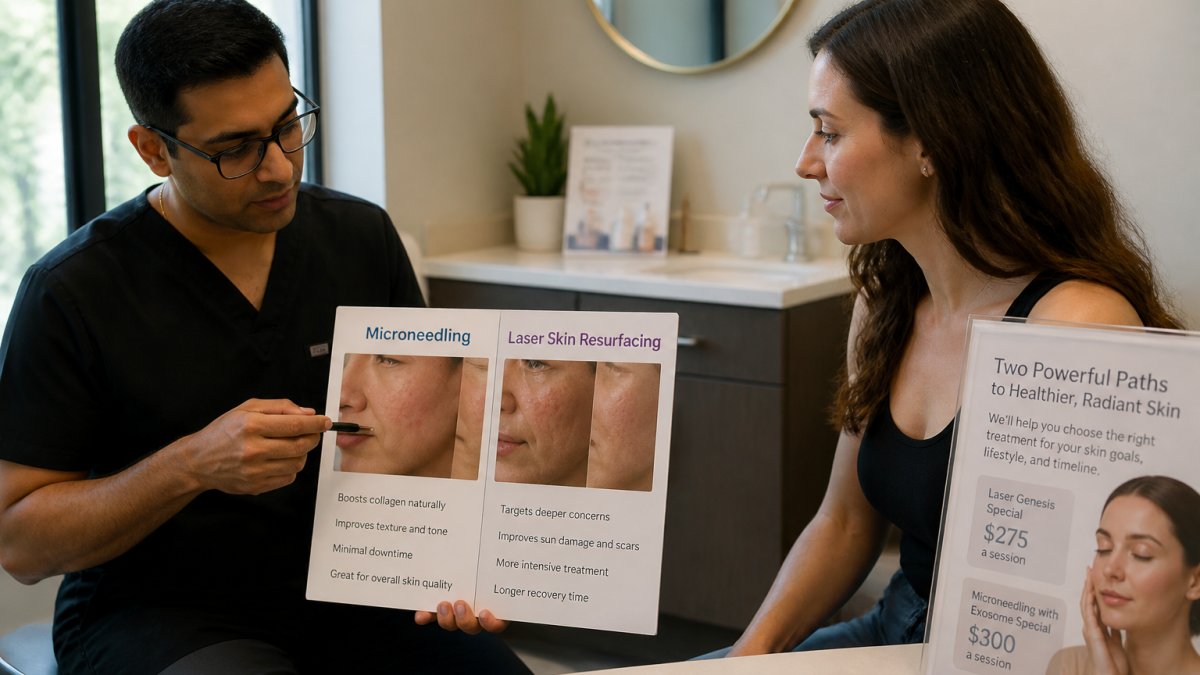
At Nova Skin Laser & Wellness, Dr. Shahzad Shah builds every treatment plan around VISIA complexion imaging and a physician examination, because the right answer depends on your skin, not on which machine is trending.
The two approaches diverge in ways that matter more than marketing suggests. One works mechanically, the other thermally. One carries pigment risk, the other carries heat risk.
How Microneedling Works: Collagen Induction Therapy Explained
Collagen induction therapy works by creating thousands of microscopic channels through the epidermis into the upper dermis. Your body reads those micro-injuries as wounds and responds by producing fresh collagen and elastin.
The clinical efficacy comes from the wound-healing cascade, not from the needles themselves. Depth control matters: shallow passes address texture and fine lines, while deeper passes target acne scarring. A common mistake is chasing aggressive depth on the first session. Most providers build gradually across a series.
Microneedling suits most Fitzpatrick skin types, including deeper tones, because it does not rely on pigment-absorbing light. That makes it a strong option for patients who want skin rejuvenation without post-inflammatory hyperpigmentation risk.
Radiofrequency microneedling adds thermal energy at the needle tip, combining mechanical stimulation with heat. It’s a different device category from standard microneedling, so ask which one you’re actually being quoted for.
How Laser Skin Resurfacing Works: Ablative, Non-Ablative, and Fractional
Laser skin resurfacing delivers thermal energy to targeted layers of skin. Ablative lasers remove the epidermis entirely, non-ablative lasers heat the dermis while sparing the surface, and fractional lasers create columns of treatment while leaving surrounding skin untouched.
Fractional delivery is why modern resurfacing recovered its reputation. Early fully ablative treatments carried long recovery periods and higher complication rates. Fractional platforms treat a fraction of the skin surface at a time, so untreated columns help the treated areas heal faster.
Non-ablative options like laser genesis take the gentlest route. They warm the dermis without removing surface skin, which is why they suit mild concerns and patients with limited downtime. Ablative and fractional treatments produce more dramatic results but demand a real recovery period.
American Academy of Dermatology guidance on laser resurfacing
Downtime, Sessions, and Cost: A Side-by-Side Comparison
Downtime and session count separate these treatments more than any other factor, and the reason is mechanical.
| Factor | Microneedling | Laser Skin Resurfacing |
|---|---|---|
| Mechanism | Mechanical micro-injuries through the epidermis into the upper dermis | Thermal energy delivered to targeted layers; ablative removes the epidermis, non-ablative heats the dermis |
| Typical downtime | 1-3 days of redness and mild tightness | 3-7 days for fractional; longer for fully ablative |
| Sessions needed | 3-6 for acne scarring, 3 for texture and pores | 1-3 for fractional; a series for gentler non-ablative options |
| Session spacing | Every 4-6 weeks to allow collagen remodeling between visits | Every 4-6 weeks for fractional; closer together for non-ablative |
| Pigment risk | Lower across skin tones because no pigment-absorbing light is used | Higher on deeper Fitzpatrick types; wavelength and settings must be matched carefully |
| Best for | Acne scarring, texture, enlarged pores, early laxity | Photodamage, fine lines, uneven tone, sun-related changes |
| Comfort | Topical numbing; most patients describe it as tolerable pressure | Topical numbing plus contact cooling; ablative options may need stronger anesthesia |
A few patterns are worth knowing before you compare quotes. Microneedling results build gradually because collagen remodeling happens over weeks to months, so the improvement you see at week two is not the final result.
Skin tone is the factor most often glossed over in online comparisons. Microneedling is generally considered suitable across Fitzpatrick skin types I through VI because it does not rely on pigment-absorbing light energy.
Pricing at Nova Skin Laser & Wellness is posted on our website, and your plan is built after a physician exam, not before it. Our current specials include laser genesis at $275 per session on our V-Laser platform, and microneedling with exosomes at $300 per session. Both are designed as series-based treatments, so the per-session figure is best read as one step in a plan rather than a one-time cost.
When you compare quotes between providers, ask what is included in the per-session price, numbing, post-treatment products, and follow-up visits vary widely and can change the real cost of a series.
American Academy of Dermatology guidance on laser resurfacing
The Benefits of Laser Genesis for Mild Skin Concerns
The benefits of laser genesis center on what it doesn’t do: it doesn’t wound the surface.
Laser genesis pairs well with a maintenance schedule. Because the skin barrier stays intact, sessions can be spaced closer together than resurfacing treatments, and most patients return to normal activity the same day.
Our V-Laser vascular system uses sapphire contact cooling to keep the experience comfortable, and at $275 per session it remains one of the most accessible ways to maintain skin rejuvenation between larger treatments.
Microneedling With Exosomes Recovery: What to Expect Week by Week
Microneedling with exosomes recovery generally runs shorter than standard microneedling, because exosome topical formulas support the skin barrier during healing. Expect redness for the first 24 to 48 hours, mild tightness through day three, and a return to normal skincare by day five.
- Days 1-2: Erythema and warmth, similar to a mild sunburn. Keep skincare minimal.
- Days 3-4: Redness fades, light flaking may appear. Continue gentle cleansing.
- Days 5-7: Skin looks calmer. Resume your normal routine, minus actives.
- Weeks 2-4: Collagen production continues. Texture and tone improve gradually.
A common mistake is restarting retinoids or acids too soon. Wait until your provider clears you, usually around day five to seven.
Cleveland Clinic overview of microneedling
How to Prepare for Skin Resurfacing and Protect Your Results
How to prepare for skin resurfacing starts weeks before your appointment, not the morning of. Stop retinoids and exfoliating acids about a week out, avoid sun exposure and tanning, and tell your provider about any history of cold sores or keloid scarring.
Aftercare decides a large share of your outcome. Sun protection is not optional. Daily broad-spectrum sunscreen and shade prevent post-inflammatory hyperpigmentation, the most common setback after resurfacing. Hydration supports the skin barrier, and gentle products beat aggressive ones during the recovery period.
- Stop retinoids and acids 5-7 days before treatment
- Avoid sun exposure and tanning for two weeks prior
- Disclose cold sore history and current medications
- Plan 3-7 days of lighter social commitments
- Stock broad-spectrum sunscreen and a gentle cleanser
Skipping sunscreen during the first two weeks after resurfacing is the fastest way to undo your results. New skin is highly vulnerable to pigment changes, and that discoloration can take months to fade.
Why Physician-Led Aesthetic Procedures Change the Outcome
Physician-led aesthetic procedures change outcomes because device settings, depth, and treatment intervals are clinical decisions, not menu selections.
The gap most online comparisons miss is skin tone.
The other gap is long-term skin health. More is not always better.
At Nova Skin Laser & Wellness, Dr. Shahzad Shah is a Diplomate of the American Academy of Aesthetic Medicine, and he builds every plan and performs the physician procedures himself.
That structure matters most for patients with deeper skin tones, melasma, or a history of scarring, where treatment matching carries real consequences. Patients should feel patient about the process, too. Collagen remodeling takes weeks to months, and the best results come from a plan followed consistently rather than a single aggressive session. Our reviews reflect that approach, clients who stay with their plan see the change compound over time.
U.S. Food and Drug Administration on laser products
Frequently Asked Questions
Is laser resurfacing more effective than microneedling?
Neither is universally more effective; they work differently. Laser resurfacing uses thermal energy to remove damaged surface layers and can produce more dramatic improvement in photodamage and fine lines in fewer sessions. Microneedling creates controlled micro-injuries that trigger collagen production with less downtime and works well for skin texture and acne scarring. The right choice depends on your skin concern, Fitzpatrick skin type, and how much recovery time you can allow. A physician-led consultation is the best way to match the method to your goals.
How do recovery times differ between laser treatments and microneedling?
Microneedling typically involves one to three days of mild redness and sensitivity, and microneedling with exosomes recovery is often faster because exosomes support the skin barrier. Non-ablative lasers may cause erythema for several days, while ablative and fractional resurfacing can require one to two weeks of visible healing. Your provider will set realistic expectations based on the device, settings, and your skin. Planning around work or social events two weeks out gives most patients a comfortable buffer.
Can darker skin tones safely receive laser skin resurfacing?
Yes, with the right device and settings. Higher Fitzpatrick skin types carry a greater risk of post-inflammatory hyperpigmentation, so wavelength selection and conservative energy matter. Non-ablative and picosecond platforms are often better suited to deeper tones than aggressive ablative resurfacing. A physician who examines your skin and reviews your history can choose a protocol that lowers risk while still improving sun spots, melasma, and texture.
Can microneedling with exosomes enhance results compared to traditional methods?
Exosomes are applied topically during microneedling to support the skin’s natural repair response. Many patients report faster recovery and improved hydration and glow compared with microneedling alone. Results still depend on session frequency, home care, and sun protection. At our practice, the microneedling with exosome special is $300 per session, and the laser genesis special is $275 per session using our V laser, so you can compare options with your provider before committing to a plan.
Choosing between microneedling and laser resurfacing is really a question about your skin, your schedule, and your risk tolerance, and no two patients answer it the same way. Nova Skin Laser & Wellness builds each plan from a physician exam and VISIA imaging, with microneedling with exosomes at $300 per session and laser genesis at $275 per session on our V-Laser platform. Book your consultation and get a straight answer about what your skin actually needs.